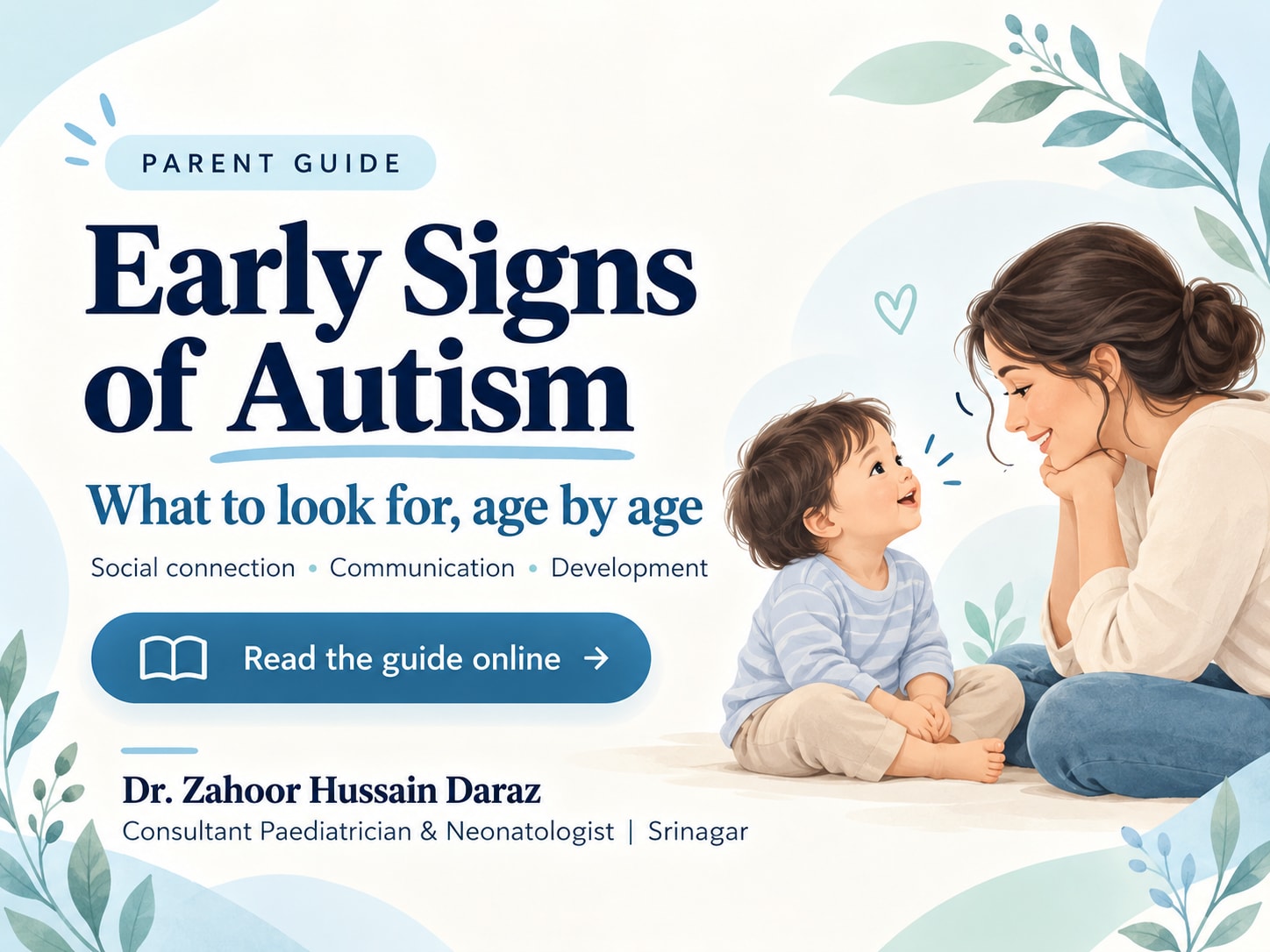

Many parents expect autism to look like a child who walks late or doesn't talk. In reality, children on the autism spectrum usually sit, crawl and walk right on time. The differences are quieter: a smile that doesn't get returned, a finger that never points, a name that gets no reaction. Because these things are so easy to miss, they often go unnoticed by families, and sometimes by doctors too.
This guide lists what to look for in the first few years of life. It is meant to help you notice and ask questions. It cannot tell you whether your child is autistic. Only a qualified professional can do that.
Why the early signs are easy to miss
Most of what we watch in babies is physical: rolling over, sitting, crawling, walking. Autism usually does not affect these. The differences show up in social skills and communication, such as using gestures like pointing, pretend play, and the back-and-forth of conversation.
Worried about your child's symptoms?
This article offers general guidance. Book a consultation for advice based on your child’s symptoms and history.
Two things are worth knowing from the start. First, many children who are not autistic show a few of these signs, and a child who is autistic may not show all of them. Second, a speech delay on its own does not mean a child is autistic. It matters more when it comes together with other signs.
Signs by age
These lists come from the CDC and Autism Speaks. Each line describes something a child is usually doing by that age. If you are not seeing it, it is worth mentioning to your doctor.
| By this age | What may be missing |
|---|---|
| 6 months | Few or no big smiles or other warm, joyful expressions. Little or no eye contact. |
| 9 months | Little or no back-and-forth sharing of sounds, smiles or facial expressions. Does not respond to their name (some lists say 9 months, others say 12). |
| 12 months | Little or no babbling. Few or no gestures such as pointing, showing, reaching or waving. Does not play simple games like pat-a-cake. |
| 15 months | Does not show you things they like, for example holding up a toy for you to see. |
| 16 months | Very few words, or none. |
| 18 months | Does not point to show you something interesting. |
| 24 months | Very few or no meaningful two-word phrases (not counting copying or repeating). Does not seem to notice when others are hurt or upset. |
| 3 years | Does not notice other children and join their play. |
| 4 years | Does not pretend to be someone else, such as a teacher or a superhero. |
| 5 years | Does not sing, dance or act for you. |
Missing one item is not a diagnosis. Children develop at their own pace. A pattern of several, or a worry you can't shake, is the reason to see a doctor.
What this can look like at home
Lists can feel abstract, so here are three everyday examples described by the American Academy of Pediatrics.
- Around 12 months: when you point at something, most babies look where you are pointing, then look back at you and smile. An autistic child may seem not to notice. This can make parents worry about their child's hearing.
- Around 15 months: most children point to things they want that are out of reach. An autistic child may take your hand and lead you to the object instead, often without looking at your face.
- Around 18 months: most children point at things that interest them and glance back to check that you are looking too. An autistic child may point mainly to ask you to get something, not to share the moment with you.
Signs that can show up at any age
Some signs are not tied to a particular age. They can appear in babies, toddlers and older children.
In how a child connects with others
- Avoiding eye contact
- Preferring to be alone
- Finding it hard to understand other people's feelings
- Delayed language
In behaviour, routines and the senses
- Lining up toys or objects and getting upset if the order is changed
- Repeating words or phrases over and over (this is called echolalia)
- Playing with toys the same way every time, or focusing on one part of an object, such as a wheel
- Getting very upset by small changes, or needing to follow certain routines
- Flapping hands, rocking the body or spinning in circles
- Unusual reactions to sounds, smells, tastes, sights or textures
Other things that often go along with autism
Many autistic children also have some of the following, though not all do: delayed movement or learning skills, hyperactive or inattentive behaviour, seizures, unusual eating or sleeping habits, constipation or other stomach problems, and anxiety. None of these on its own means a child is autistic.
When a child loses a skill
Some children develop a few words or social skills and then lose them. According to the American Academy of Pediatrics, this happens in about one in four children later diagnosed with autism, usually between 15 and 24 months. It can happen suddenly or slowly, and the child may also become more withdrawn.
If your child stops using words, babbling or social skills they used to have, do not wait to see if it passes. Book a visit.
What happens at screening
The American Academy of Pediatrics recommends that every child is screened for autism at the 18-month and 24-month check-ups, on top of the routine developmental checks done at well-child visits. Autism Speaks also lists developmental checks at 9, 18 and 30 months.
One commonly used tool is a short questionnaire called the M-CHAT-R. It takes a few minutes and helps decide whether a professional should take a closer look. It is a screening step, not a diagnosis. If the answers raise concern, the next step is an evaluation by a doctor or specialist.
Autism can often be diagnosed reliably by an experienced professional by about age 2. Starting support early can improve outcomes for many children, which is why waiting and hoping is not the best plan when you have a real concern.
When to see a doctor
See your child's doctor if:
- your child is missing several of the signs listed above for their age,
- your child has lost words or skills they once had,
- or you simply feel something is not right. You know your child best, and your concern is reason enough.
You do not need to be sure, and you do not need to wait for the next scheduled check-up. A visit can help you understand what is typical for your child's age and whether any further assessment is needed.
Two things worth saying clearly
Autism is not caused by anything parents did or did not do. And vaccines do not cause autism. If you hear otherwise, please bring the question to your doctor rather than carrying the worry alone.
Talk to Dr. Zahoor
If you are worried about your child's development, you can book a consultation with Dr. Zahoor Hussain Daraz at Medicare Super Speciality Hospital, Kak Sarai, Karan Nagar, Srinagar. You can also read more about growth and development checks, or book an appointment online.
This article is for general education. It is not a diagnosis and is not a substitute for a consultation with your child's doctor.